
Waking up tired and needing coffee to power through the day is often dismissed as normal. However, Chinese medicine views persistent fatigue as a real signal that your body's energy production requires attention.
Waking up already tired. Reaching for a third coffee by lunchtime. Getting through the working day but having nothing left for the evening. Persistent low energy is one of the most common complaints practitioners hear — and one of the easiest to dismiss as "just how life is now." Chinese medicine takes it more seriously: sustained fatigue is a genuine sign that something in the body's energy production needs attention.
Why Chinese medicine takes fatigue seriously
In Chinese medicine, vitality depends on Qi — the body's functional energy — being generated, stored and moved correctly. Qi is produced mainly by the Spleen (from food) and the Lungs (from breath), and stored at a deeper level by the Kidneys, which hold our constitutional reserves. When any part of this system is under strain for too long, energy production falls behind demand, and fatigue sets in.
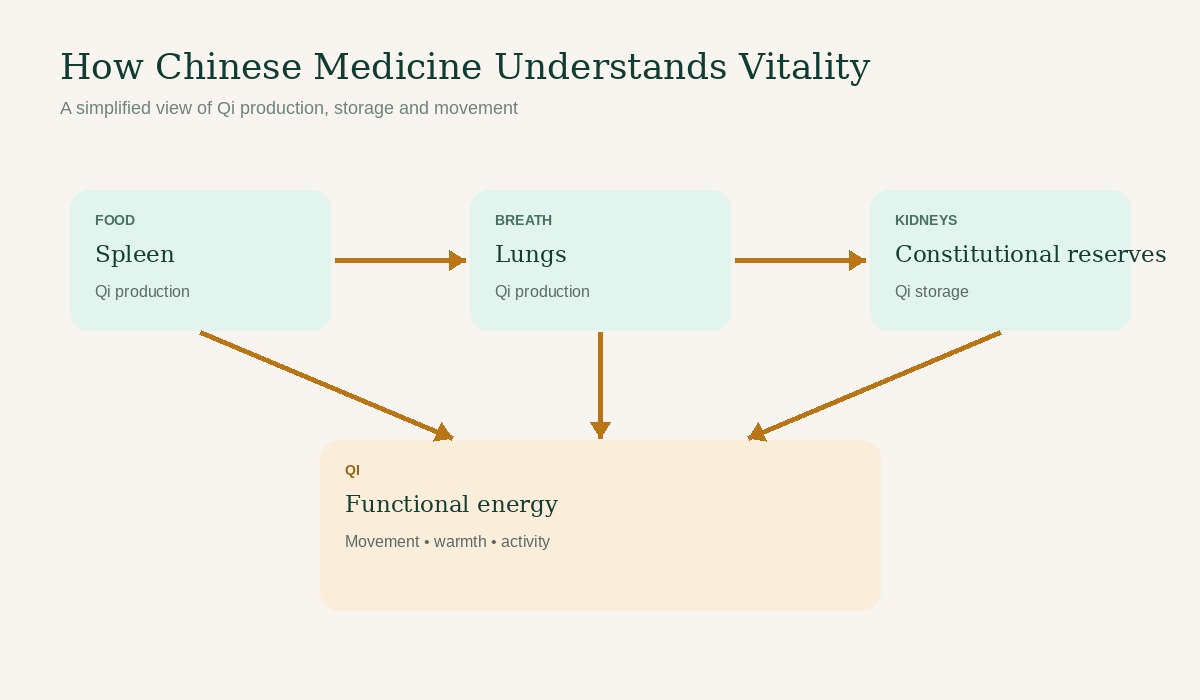
A simplified visual summary of the Traditional Chinese Medicine model described in this article: food and breath contribute to Qi, while the Kidneys are described as holding deeper constitutional reserves.
Crucially, Chinese medicine distinguishes between different kinds of tiredness. Someone who is tired but restless and cannot switch off at night is in a different state, physiologically, from someone who is tired, cold and simply wants to sleep all day. Treating both the same way rarely works.
"Where Qi is abundant, the body moves with ease. Where Qi is deficient, even small tasks become a burden."
The most common patterns behind low energy
Fatigue is rarely one thing. In clinical practice, it usually falls into one or more of these patterns:
- Spleen Qi Deficiency — Tiredness that is worse after eating, a heavy feeling in the limbs, poor appetite, loose stools, and a tendency to bruise easily. Often the foundational pattern, especially in people who skip meals or eat irregularly.
- Kidney Yang Deficiency — Deep, cold fatigue, a general lack of drive or motivation, low back or knee soreness, feeling the cold more than others, and low libido. Common with age, chronic illness, or long-term overwork without adequate rest.
- Kidney Yin Deficiency — Fatigue combined with restlessness, a warm feeling in the palms, soles and chest in the afternoon or evening, night sweats, and a dry mouth. Often seen alongside disrupted sleep.
- Qi and Blood Deficiency — Fatigue with pale complexion, dizziness on standing, palpitations, and thinning hair. Frequently follows heavy blood loss, childbirth, surgery, or a long illness.
- Liver Qi Stagnation with underlying deficiency — The classic "tired but wired" pattern: exhausted all day, yet unable to relax or sleep properly at night, often with irritability or tension. Usually driven by chronic stress layered on an already depleted system.
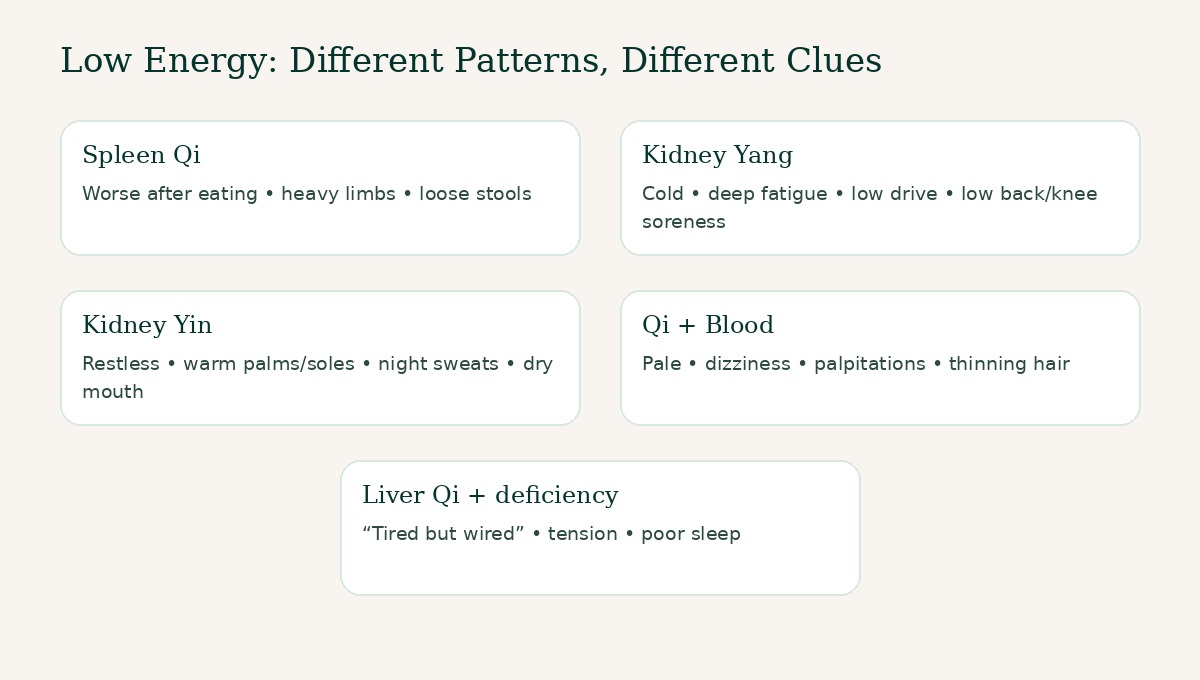
The article's five example patterns of low energy, with characteristic clues used in Traditional Chinese Medicine pattern differentiation.
Identifying which pattern (or combination) applies is the difference between a treatment plan that actually restores energy and one that only masks the symptom.
What treatment looks like
Acupuncture for fatigue typically combines points that tonify Qi — such as ST 36 (Zusanli) and Qihai (CV 6) — with points chosen for the specific pattern involved: Kidney points such as KI 3 for Yang or Yin deficiency, or calming Liver points where stress and restlessness are part of the picture. Moxibustion (the gentle warming of acupuncture points with mugwort) is often used alongside needling, particularly for Yang deficiency patterns where cold and depletion predominate.
Qihai (CV 6) — a key point for restoring energy reserves. Location is illustrative; exact placement is verified by your practitioner in clinic.
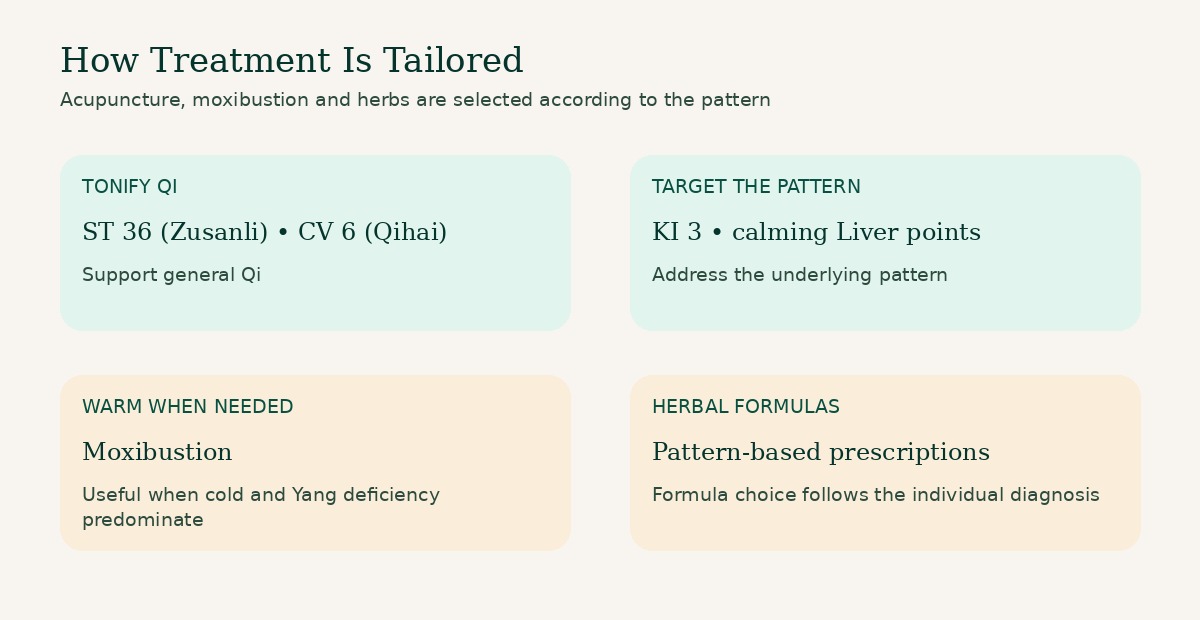
Treatment is presented as pattern-based rather than as a one-size-fits-all response to fatigue.
Herbal medicine plays a significant role here. Classical formulas such as Bu Zhong Yi Qi Tang (Tonify the Middle and Augment the Qi Decoction) are used for Spleen Qi deficiency with a sinking, heavy quality of fatigue; Shi Quan Da Bu Tang (All-Inclusive Great Tonifying Decoction) addresses combined Qi and Blood deficiency; and Jin Gui Shen Qi Wan (Kidney Qi Pill) supports Kidney Yang. Each prescription is built around the individual's pattern, not simply "fatigue" as a single label.
Three things to try this week
1. Support Qihai and Guanyuan, the body's energy reservoirs. These two points sit on the midline of the lower abdomen — Qihai roughly two finger-widths below the navel, Guanyuan roughly four finger-widths below. Apply gentle warmth (a hot water bottle wrapped in a towel works well) for 10–15 minutes each evening.
2. Eat warm, regular meals — especially breakfast. Skipping breakfast or relying on cold smoothies and salads first thing asks the Spleen to work harder than it needs to. A simple warm breakfast — porridge, eggs, or a light soup — gives digestion an easier start to the day and, over time, supports more stable energy.
3. Protect a wind-down window before bed. The "tired but wired" pattern is made worse by screens, emails, and stimulating conversations right up until lights-out. Give yourself 30 minutes of low-stimulation time before bed to let the Liver Qi settle before sleep.
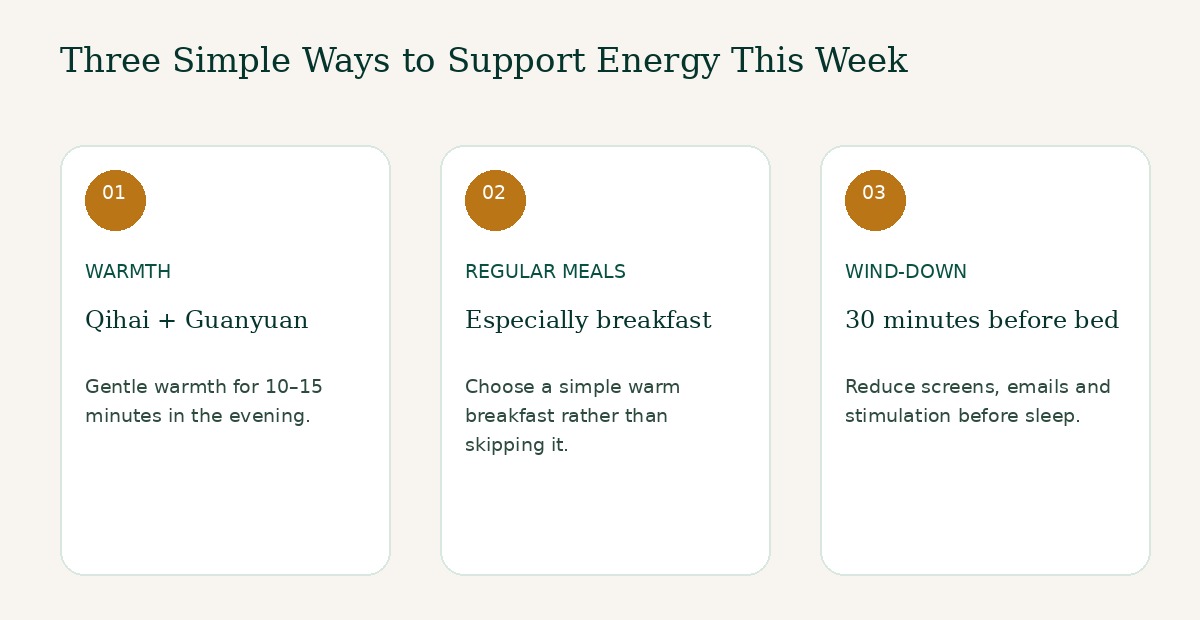
Three practical suggestions highlighted in the article for supporting energy during the week.
When to seek treatment
If low energy has become your normal state for more than a few weeks — particularly if it is affecting your work, relationships, or mood — it is worth addressing properly rather than pushing through it. That said, persistent fatigue can occasionally signal something that needs medical assessment first: unexplained weight loss, fever, shortness of breath, or fatigue that comes on suddenly and severely should always be checked with your GP before anything else. Chinese medicine works well alongside conventional care, as part of a considered plan to restore energy for the long term, not just get through the week.