
A migraine is not simply a bad headache. It is a debilitating neurological event that can last for hours or days, disrupting work, relationships, and quality of life. Conventional medicine offers relief — but for many people, the attacks keep coming.
How Chinese medicine understands migraines
In Western medicine, migraines are classified primarily by their symptoms — the throbbing pain, the sensitivity to light and sound, the nausea, the aura. Treatment focuses on interrupting or preventing the neurological cascade that produces them.
Chinese medicine asks a different question: why is this particular person getting these particular headaches, at these particular times? The location of the pain, its quality, what triggers it, what makes it better or worse, and the overall constitution of the patient are all taken into account. The same symptom — a pounding unilateral headache — may have very different roots in different people.
"All headaches have a root. The pain is the branch — the symptom you feel. The root is what we treat. Treat only the branch, and the branch grows back."
The most common patterns behind migraines
In clinical practice, migraines typically fall into one of these patterns:
- Liver Yang Rising — Throbbing temporal headaches triggered by stress or poor sleep, accompanied by irritability and dizziness. The most frequently seen pattern.
- Liver Qi Stagnation with Blood Stasis — Fixed, stabbing pain often linked to the menstrual cycle. Common in women with hormonal migraines.
- Kidney and Liver Yin Deficiency — Dull, hollow headaches worsened by fatigue, often with tinnitus and lower back soreness. More common in midlife.
- Wind Invasion — Sudden-onset headaches following exposure to cold, wind, or weather changes, typically affecting the occiput and neck.
- Phlegm-Damp Obstruction — Heavy, oppressive headaches with nausea and mental fog, often related to diet and digestive weakness.
Each pattern calls for a distinct approach. Two patients with identical symptoms may leave with entirely different acupuncture prescriptions and herbal formulas.
What treatment looks like
Acupuncture for migraines works on two levels: acute relief during or after an attack, and constitutional treatment to reduce the frequency of future episodes. Key points include GB 20 (Fengchi) at the base of the skull — one of the most powerful points for any head complaint — combined with points on the Gallbladder, Liver, and Du channels according to the individual pattern. Ear acupuncture is often added for immediate pain relief.
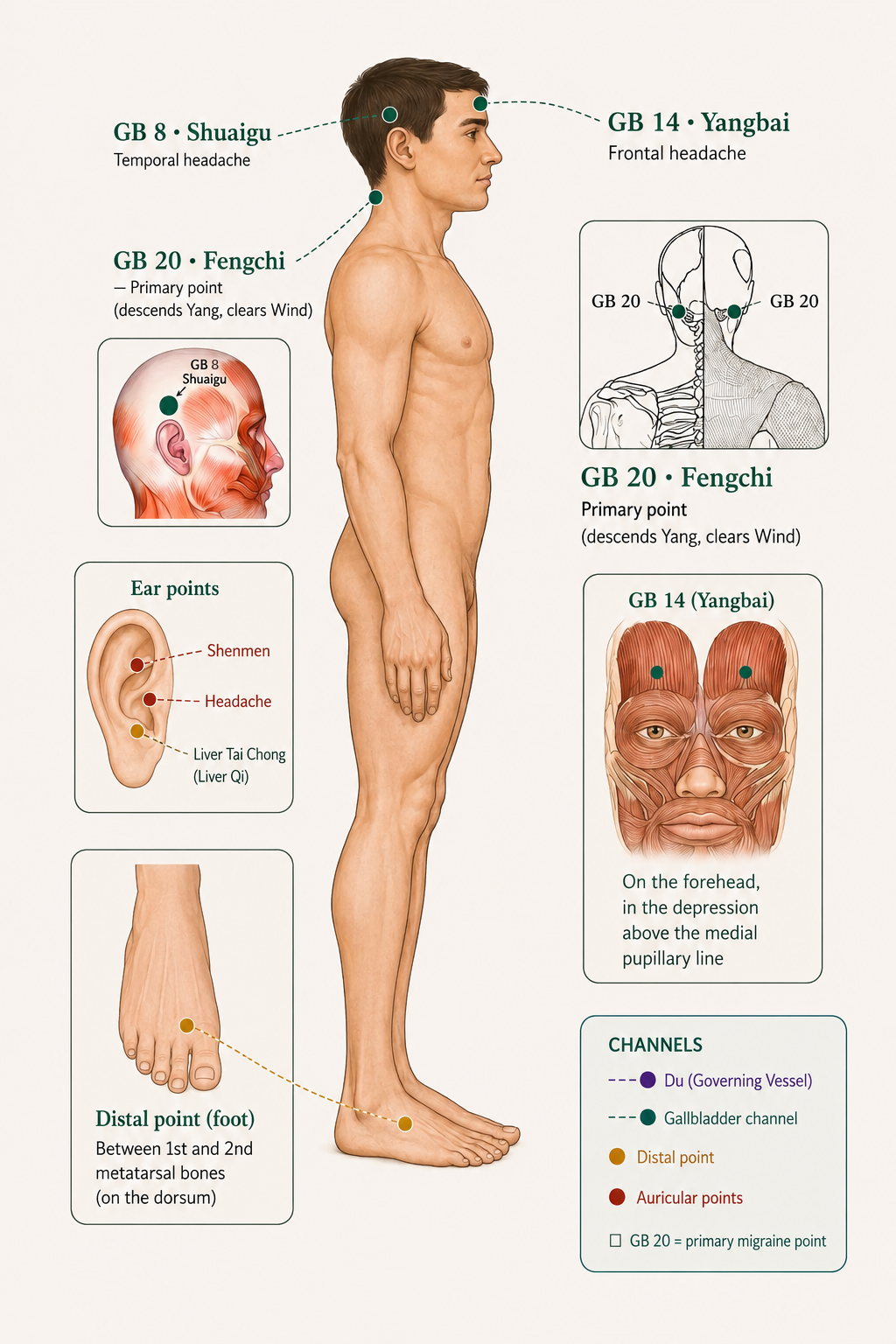
Points are illustrative — exact location verified by your practitioner in clinic
Herbal medicine is frequently used alongside needling. Classical formulas such as Tian Ma Gou Teng Yin address Liver Yang Rising, while Xue Fu Zhu Yu Tang targets Blood Stasis. Each prescription is adapted to the patient.
Research supports this approach. A 2022 Cochrane Review of 22 trials found that acupuncture was at least as effective as prophylactic drug treatment, with fewer side effects and a more durable response.
Three things to try between appointments
1. Press GB 20 at the first sign of an attack. Place your thumbs in the hollows at the base of your skull, on either side of the spine, where the neck muscles meet the occiput. Apply firm upward pressure for 2–3 minutes while breathing slowly and deeply. This point directly descends rising Liver Yang and can interrupt a migraine in its early stage.
2. Avoid the three main triggers in Liver Yang Rising. In Chinese medicine, the Liver is particularly sensitive to stress, irregular sleep, and alcohol. If your migraines follow a pattern of stress, poor sleep the night before, or red wine, this suggests a Liver Yang component. Even small adjustments — consistent sleep times, a 10-minute wind-down before bed, reducing alcohol — can meaningfully reduce attack frequency.
3. Keep a pattern diary. Before your first consultation, note the location of pain (one side? both? forehead? back of head?), what triggers it, what time of day or cycle it tends to occur, and what makes it better or worse. This information is invaluable for accurate TCM diagnosis and significantly shortens the treatment planning process.
When to seek treatment
If you are reaching for painkillers more than two or three times per month, it is worth considering a course of acupuncture. Medication overuse headache — in which frequent painkillers paradoxically increase attack frequency — is one of the most under-recognised causes of chronic daily headache. Chinese medicine does not ask you to choose between conventional and traditional care: the goal is not to suppress the migraine, but to address what is causing it.