You are exhausted, yet the moment your head touches the pillow your thoughts begin racing. You toss and turn, check the clock, and watch the hours slip away. Sound familiar?
How Chinese medicine understands insomnia
Western medicine typically treats insomnia as a single condition, often reaching for sedatives or melatonin. Chinese medicine takes a different view: it asks why you cannot sleep, and the answer varies from person to person.
In TCM theory, restful sleep depends on the Shen — the mind-spirit — settling peacefully into the Heart at night. When the Heart is nourished by adequate Blood and Yin, the Shen descends naturally and sleep comes easily. When these are depleted or disturbed, the Shen becomes restless and the mind cannot switch off.
"The Heart houses the Shen. When Heart Blood is sufficient, sleep is sound. When it is deficient, the Shen wanders and sleep is disturbed."
The most common patterns behind insomnia
Not all insomnia is the same. In clinical practice, we commonly see these patterns:
- Heart and Spleen deficiency — difficulty falling asleep, light sleep with many dreams, poor appetite, tiredness. Often seen in people who worry excessively or have been under prolonged mental strain.
- Heart and Kidney disharmony — falling asleep but waking repeatedly through the night, often with night sweats, lower back soreness, and a feeling of heat in the palms and soles. Common during menopause or after long periods of overwork.
- Liver Qi stagnation with Heat — difficulty falling asleep due to an agitated mind, often accompanied by irritability, headaches, or a bitter taste in the mouth. Typically linked to stress, frustration, or suppressed emotions.
- Phlegm-Heat disturbing the Heart — restless sleep with vivid or disturbing dreams, a feeling of heaviness, nausea. Often associated with irregular eating or excessive consumption of rich, greasy foods.
Each of these patterns requires a different treatment strategy. This is why two patients with "insomnia" may receive completely different acupuncture point prescriptions and herbal formulas.
Three things you can do tonight
1. Warm your feet before bed. Soak your feet in warm water for 15 minutes before sleeping. In Chinese medicine, this draws the Qi downward and away from the head, calming the Shen. Add a few slices of fresh ginger if your feet tend to feel cold.
2. Press the Anmian point. Find the soft spot just behind your earlobe, in the hollow between the ear and the base of the skull. Gently massage both sides with your fingertips in small circles for 2–3 minutes while breathing slowly. Anmian literally means "peaceful sleep."
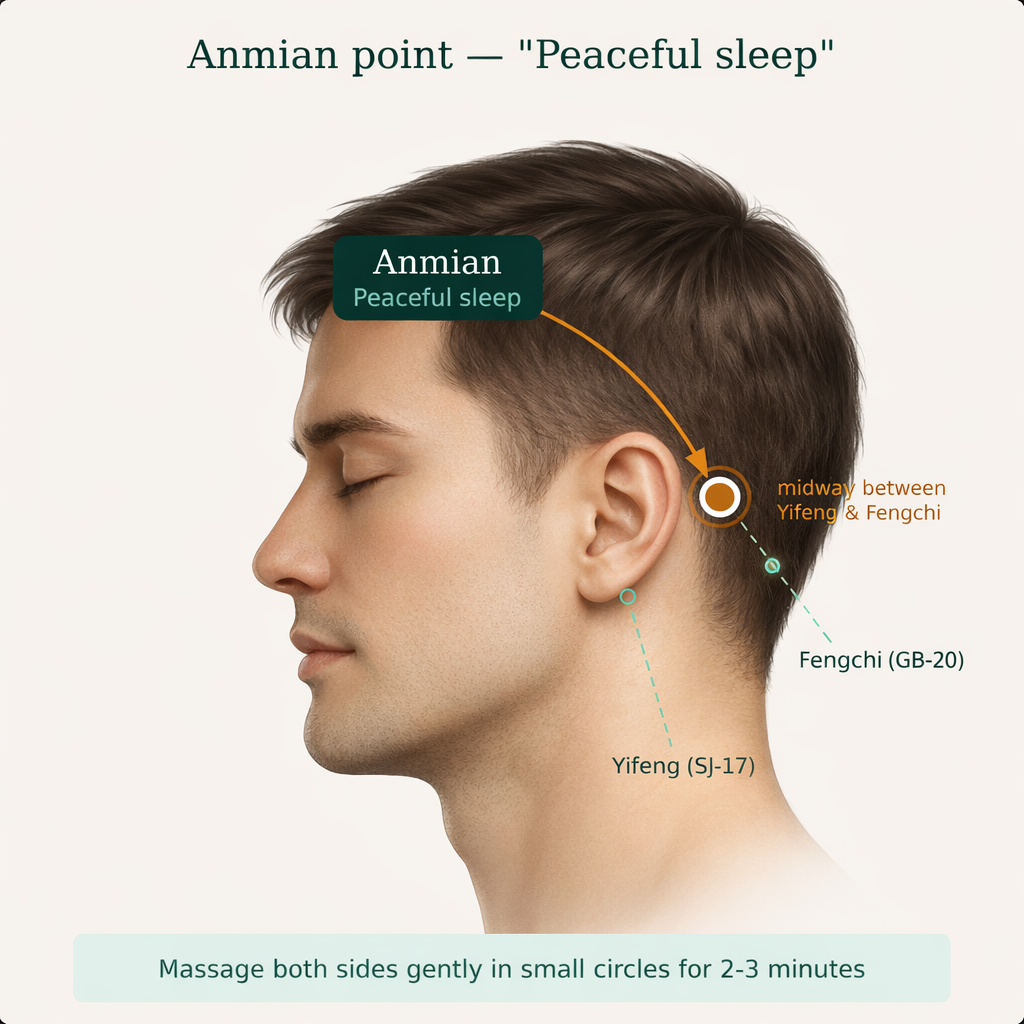
The Anmian point is located in the soft hollow behind the earlobe, between the ear and the base of the skull.
3. Avoid screens and heavy meals after 9pm. The Stomach meridian is most active between 7–9am. Eating late forces the body to digest when it should be winding down, generating heat that rises and disturbs the Heart. Blue light from screens has a similar agitating effect on the Shen.
What treatment looks like
Acupuncture for insomnia typically involves points on the Heart, Spleen, and Kidney channels, combined with calming points on the head and ears. Many patients report improved sleep within the first two or three sessions, though deeper constitutional patterns may require six to eight treatments for lasting change.
Herbal medicine is often used alongside acupuncture — classical formulas such as Suan Zao Ren Tang (Sour Jujube Decoction) or Tian Wang Bu Xin Dan (Emperor of Heaven's Special Pill) have been used for centuries to nourish Heart Blood and calm the Shen.
If insomnia has become a regular part of your life, it is worth exploring what your body is trying to tell you. A diagnostic consultation can identify the underlying pattern and set out a clear treatment plan — without relying on sleeping pills.